

What Makes Clothing Quality Premium: A 2026 Guide
Table of Contents
- What Makes Clothing Quality Premium
- High-Quality Clothing Materials and Fiber Selection
- Garment Construction and Stitching Quality
- How to Tell If Clothes Are Good Quality: A Practical Inspection Guide
- Fabric Performance: Durability, Breathability, and Wear Resistance
- Premium vs. Luxury Clothing: Understanding the Difference
- Quality Control and Textile Testing Standards
- Production Volume and Manufacturing Consistency
- Distinguishing Premium Quality From Premium Pricing
- Clothing Quality Checklist for Smart Shopping
- Garment Lifespan and Long-Term Value
- Frequently Asked Questions
Last Updated: October 7, 2026
What Makes Clothing Quality Premium
Premium clothing quality isn't about the price tag, it's about what you can see, feel, and measure when you examine a garment carefully. At Chloe Athena, we understand that affordable pricing and premium quality aren't mutually exclusive.

Clothing quality premium depends on five core elements working together. First, the fiber content matters, natural materials like cotton and wool perform differently than synthetics, and blends introduce trade-offs you need to understand.
This guide covers exactly how to evaluate each of these factors so you can distinguish genuine premium quality from premium pricing alone.
High-Quality Clothing Materials and Fiber Selection
The foundation of any premium garment starts with fiber choice. Natural fibers like cotton, wool, linen, and silk have been the standard for quality clothing for centuries, and there's a reason: they perform reliably and age well.
Understanding fiber content means reading labels carefully. A garment labeled "100% cotton" performs differently than one that's "80% cotton, 20% polyester." The blend changes how the fabric stretches, shrinks, breathes, and maintains its shape.
Natural Fibers vs. Synthetic Blends
Natural fibers breathe, absorb moisture, and feel softer against skin, qualities that matter for comfort during extended wear. Cotton allows air circulation, making it ideal for warm-weather pieces.
Synthetic fibers excel at durability and easy care. Polyester resists wrinkles and fading, which is why it's blended into performance wear. Nylon adds stretch and strength to fabrics.
Premium garments often use strategic blends. A 95% polyester, 5% spandex blend, like the Heavy Knit Striped Turtle Neck Knit Sweater from Chloe Athena, provides warmth and durability while maintaining wearability.

Organic Certification and Sourcing Standards
Organic certification doesn't automatically mean better quality, it means the fiber was grown without synthetic pesticides or fertilizers.
Look for certifications like GOTS (Global Organic Textile Standard) or OCS (Organic Content Standard) when shopping.
Sourcing standards matter because they indicate consistency. A manufacturer that sources from the same suppliers year after year typically produces more consistent garments than one that switches suppliers to chase lower costs.
Garment Construction and Stitching Quality
How a garment is assembled determines whether it holds up or falls apart. Two identical fabrics can produce vastly different results depending on construction technique. Premium garments use reinforced seams, quality thread, and finishing methods that prevent unraveling.
Seam Strength and Thread Quality
Seams are stress points. When you wear a shirt, stretch fabric, or wash a garment, seams bear the load.
Thread quality matters as much as stitch count. Polyester thread resists breakage better than cotton thread, which is why premium garments often use polyester thread even in natural-fiber garments.
Seam finishing prevents unraveling. Premium garments use techniques like flat-felled seams (common in denim and workwear) or bound seams (finished edges wrapped in bias tape) that lock threads in place.
Finishing Details: Buttons, Hems, and Cuffs
Details reveal quality. Premium garments use reinforced buttons sewn through multiple layers with thread that won't snap. Budget buttons are often attached with two passes of thread; quality buttons get four or more, plus a reinforcement shank underneath that distributes stress.
Hems tell a story. Hand-stitched hems are more expensive but create invisible stitching that lasts longer. Machine-stitched hems are faster but visible. Premium garments use consistent hem width (typically 1.5 to 2 inches), while budget pieces vary.
Cuffs, collars, and waistbands on premium garments are reinforced with interfacing or bias tape that prevents stretching and maintains shape through washing. The Mens Solid Full Zip Sweater from Chloe Athena features ribbed collar and cuffs designed to maintain their shape, a detail that costs slightly more but extends garment life significantly.
How to Tell If Clothes Are Good Quality: A Practical Inspection Guide
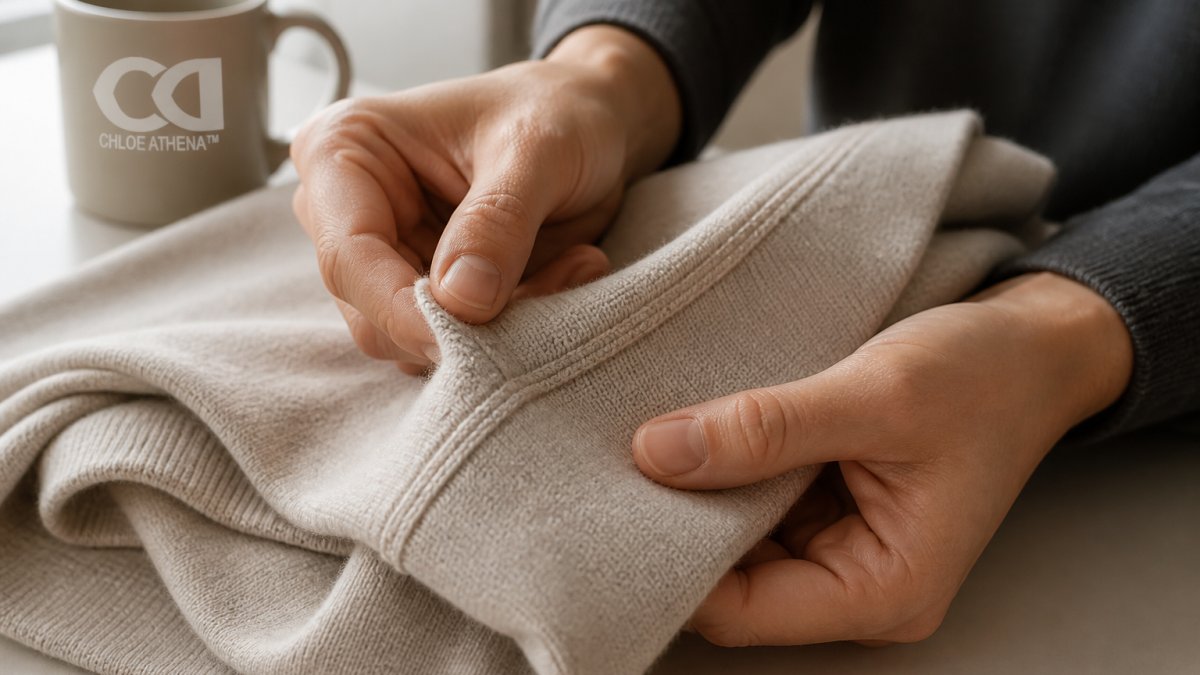
Most shoppers evaluate clothing by price and brand. A better method is a five-minute, hands-on inspection that checks the same things a quality-control auditor checks: fabric density, seam integrity, stitch density, hardware attachment, and pattern alignment.
Step 1: Read the Fiber Label Before You Touch the Garment
Start with the label, because fiber content sets the ceiling on everything else. Look for percentages, not vague terms. "100% cotton" and "60% cotton, 40% polyester" behave differently in shrinkage, pilling, and breathability.
Also check for a care label with a fiber-content statement and a country of manufacture. In the U.S., the FTC's Textile Fiber Products Identification Act requires most textile garments to carry fiber content, country of origin, and either the manufacturer or a registered identification number (the FTC).
Step 2: The Fabric Density and Hand Test
Pick up the garment and assess three things in sequence:
- Weight. A quality cotton tee has heft; a papery, limp tee usually signals a low yarn count or loose knit. Lightweight is not automatically bad, linen is naturally light, but the fabric should feel intentional, not thin in spots.
- Consistency. Run your palm across the surface. You are feeling for thin spots, stiff patches, or slubs that indicate uneven yarn or rushed finishing. Quality fabric feels uniform edge to edge.
- Recovery. Gently stretch a section along the side seam or hem, then release. Premium knits snap back to shape almost immediately. Fabric that stays stretched has poor elastic recovery, which predicts sagging at the elbows, knees, and neckline.
A quick density check for wovens: hold the fabric up to a light. If you can see individual yarns clearly and light passes through unevenly, the weave is loose. Tightly woven fabric diffuses light more evenly.
Step 3: Seam and Stitch Inspection
Turn the garment inside out. This is where construction quality is visible.
- Stitch density. Count stitches along one inch of a main seam. Quality garments commonly run 10-14 stitches per inch on structural seams; budget garments often run 6-8. More stitches per inch distribute stress across more thread and resist seam failure.
- Seam type. Look for flat-felled seams (the folded, double-stitched seam common in denim and workwear), bound seams (raw edges wrapped in bias tape), or French seams (encased raw edges, common in fine shirting). A raw, serged edge that is not enclosed is the cheapest finish and frays fastest.
- Seam puckering. Wrinkled or wavy seams mean the fabric was fed unevenly through the machine or the thread tension was wrong. Either way, the seam is weaker and will distort after washing.
Step 4: Hardware, Buttons, and Zippers
Hardware is a fast tell because it is cheap to upgrade and expensive to replace.
- Buttons. Try to rotate a button between your fingers. A quality button is sewn with a shank (a small thread column underneath) or through a reinforced cross-stitch with multiple passes. Flat, two-pass buttons pop off. On coats and blazers, look for buttons with a raised rim or a branded back, a sign of a specified component rather than a commodity one.
- Zippers. Check the brand on the pull. YKK is the most widely specified zipper manufacturer in the apparel industry, and its presence is a reasonable signal that the brand chose a known component supplier. Test the zipper by zipping it fully and feeling for snags. A quality zipper glides without catching and locks when the pull is down.
- Snaps, rivets, and hooks. These should be set flush with the fabric, not crushing or puckering it. Loose rivets on denim are a common failure point.
Step 5: Pattern Alignment and Symmetry
Lay the garment flat and check symmetry. Stripes, plaids, and prints should match at the side seams and center front. On a quality garment, a horizontal stripe meets its mirror image at the seam; on a rushed garment, the pattern breaks by a quarter inch or more.
Also check that the left and right sides of the garment are the same length. Uneven hems, mismatched sleeve lengths, and off-center plackets indicate poor cutting or poor quality control.
Step 6: The Wash-Test Prediction
You cannot wash a garment in the store, but you can predict how it will behave. Look for a care label that specifies wash temperature and drying method.
If the label says "wash separately before wearing" or warns about color transfer, treat that as a signal the dye is not fully bonded. That is not automatically a dealbreaker for a garment you love, but it is a real cost in care and risk.
A Quick Scoring Method
Score each garment 0-2 on six checks: fiber label specificity, fabric density and recovery, stitch density and seam finish, hardware attachment, pattern alignment, and care-label clarity. A score of 10-12 indicates a garment built to last; 6-9 is average; below 6 means you are paying for the label, not the construction. This is the same logic a quality auditor uses, just compressed into a store aisle.
Fabric Performance: Durability, Breathability, and Wear Resistance
Premium fabrics perform reliably over time. They resist common wear issues like pilling, shrinkage, and color fading. Understanding how different fabrics behave helps you choose garments suited to your lifestyle.
Durability comes from fiber strength and weave tightness. Densely woven fabrics resist tearing and pilling better than loosely woven ones.
Breathability matters for comfort. Natural fibers like cotton and linen allow air circulation, keeping you cool. Wool regulates temperature naturally.
Pilling, Shrinkage, and Colorfastness
Pilling happens when short fibers break loose and ball up on the fabric surface. Premium garments resist pilling because manufacturers use long-staple fibers and tight weaves.
Shrinkage occurs when fabric fibers relax after washing. Premium garments are pre-shrunk during manufacturing so they shrink minimally (typically under 3%).
Colorfastness measures how well dyes adhere to fibers. Premium garments use dyeing processes that bond color to fiber; budget pieces sometimes use surface dyes that wash out or bleed onto other garments.
Premium vs. Luxury Clothing: Understanding the Difference
Premium and luxury are often used interchangeably, but they describe different market positions. Understanding the distinction helps you avoid overpaying for branding rather than quality.
Premium clothing delivers excellent quality at reasonable prices.
Luxury clothing emphasizes exclusivity, limited production, and design innovation. It uses the finest materials available, often hand-finished details, and limited production runs.
The practical difference: a premium garment delivers quality that justifies its price through durability and performance.
Quality Control and Textile Testing Standards
Most articles about premium clothing say "quality control matters" and stop there. The more useful question is: what is actually being measured, against what standard, and what does a passing result look like? That is where objective quality indicators come in, the tests that turn "this feels premium" into a number a manufacturer can specify and a shopper can infer.
The Core Tests Behind Durable Fabric
Textile testing is a mature field with published methods. The most common tests a premium manufacturer runs on fabric before it is cut:
- Abrasion resistance. A machine rubs fabric against an abrasive surface until a hole forms or the appearance changes. Results are reported as a cycle count, higher is more durable. This predicts how a garment holds up at cuffs, collars, and seat seams.
- Pilling resistance. Fabric is tumbled against itself or an abrasive liner for a set number of cycles, then compared against photographic standards. This is why long-staple cotton and tightly twisted yarns resist pilling: fewer short fibers are available to work loose and ball up.
- Dimensional stability (shrinkage). Fabric is washed and dried under specified conditions, then re-measured. Premium knits are typically pre-shrunk to hold shrinkage under about 3% in either direction; unshrunk budget knits can move 5-8% or more, which is why a medium can fit like a small after one wash.
Who Sets the Standards
In the U.S., ASTM International publishes many of the consensus test methods used across the apparel industry, and AATCC (the American Association of Textile Chemists and Colorists) publishes the colorfastness and appearance-retention methods. These are voluntary consensus standards, no federal agency requires a brand to run them, but they are the reference points manufacturers cite when they claim a fabric is tested.
ASTM International textile testing standards
What Quality Control Actually Looks Like on a Production Line
Testing is only half of quality control. The other half is inspection at defined stages:
- Incoming fiber and yarn inspection. Verifies the fiber content and yarn count match the specification before fabric is knit or woven.
- Fabric inspection. Rolls are checked for defects, holes, slubs, shade variation, often against a points-per-yard system where a roll is rejected if defects exceed a threshold.
- In-line inspection during sewing. Operators or floor inspectors check seams, stitch density, and alignment as garments move through the line, not only at the end.
- Final audit. Finished garments are measured against the size spec and inspected for defects. A common industry practice is an AQL (Acceptable Quality Limit) sampling plan, which defines how many units to inspect and how many defects are allowed before a batch is rejected.
A brand that spot-checks a handful of finished garments is running a different process than one that inspects at every stage. The difference shows up as consistency: buying the same item twice produces nearly identical results.
Why This Matters to a Shopper
You cannot run an abrasion test in a store aisle, but you can use the same indicators to make better decisions:
- A care label that specifies a shrinkage range or says "pre-shrunk" is a claim the brand is willing to put in writing.
- A brand that publishes its test methods or names its component suppliers (zipper, thread, interlining) is signaling that it specified those components rather than accepting whatever the factory had on hand.
- A garment with consistent sizing across two purchases is evidence of a controlled production process; inconsistent sizing is evidence of the opposite.
The Limits of Testing
Testing has real limits. A fabric can pass every lab test and still be cut and sewn poorly, which is why construction inspection matters as much as fabric testing. A brand can also test to a low threshold and still say "tested." The useful question is not whether a brand tests, but what it tests for, against what standard, and what it does when a batch fails.
Production Volume and Manufacturing Consistency
High-volume manufacturers produce cheaper garments but sacrifice consistency.
Premium manufacturers often produce lower volumes, which allows quality control. Smaller production runs mean supervisors can inspect more garments personally.
This doesn't mean premium garments are handmade, most aren't. It means production speed is managed to prioritize quality.
Manufacturing consistency means buying the same item twice produces nearly identical results. Size runs are consistent, colors match, and construction quality doesn't vary.
Distinguishing Premium Quality From Premium Pricing
This is where many shoppers get confused. A high price doesn't guarantee quality; sometimes you're paying for branding, design, or luxury positioning rather than superior materials or construction.
Ask yourself: what justifies the price?
Compare garments side by side. Feel the fabric, examine the stitching, check the seams.
Look at fiber content and construction details.
Check return policies and customer reviews. Premium brands stand behind their garments with generous return policies because they know quality will satisfy customers.
Clothing Quality Checklist for Smart Shopping
Use this checklist when evaluating garments:
- Fiber content is clearly labeled with percentages
- Fabric feels substantial and consistent, no thin spots or rough areas
- Stitching is even with 12+ stitches per inch on seams
Garment Lifespan and Long-Term Value
Premium quality directly extends garment lifespan.
Lifespan depends on fiber quality, construction, and care.
Repairability matters too. Premium garments are worth repairing, replacing a zipper or restitching a seam costs less than replacing the garment.
Calculate true cost per wear. A premium sweater costing $50 worn 100 times over three years costs $0.50 per wear.
Chloe Athena's approach focuses on this long-term value. The Melton Lettermans Varsity Jacket at $49.50 uses quality polyester Melton and reinforced construction designed to last seasons, not months. The Plus Size High Quality Buttery Soft Solid Knit Turtleneck at $14.40 combines quality fiber blends with thoughtful construction, affordable pricing without sacrificing durability.

Premium clothing quality comes down to measurable factors: fiber choice, construction technique, quality control, and honest pricing.
Frequently Asked Questions
What makes clothing quality premium?
Premium clothing quality combines superior materials, precise construction, and rigorous testing. Look for natural or high-grade synthetic fibers, reinforced seams with tight stitching, quality buttons and hardware, and evidence of quality control testing. Premium garments retain their shape, color, and structural integrity through repeated wear and washing. The difference between premium and mass-produced clothing shows in fabric weight, finishing details, and how long a piece actually lasts in your closet.
How can you tell if clothes are high quality?
Inspect the garment by feeling the fabric weight and texture, checking seam construction for tight, even stitching, examining hems and cuffs for neat finishing, and looking for secure buttons and hardware. High-quality clothing rarely has loose threads, pilling, or uneven dye. Check the care label for fiber content; natural fibers like cotton, wool, and linen typically indicate better quality than cheap synthetics. Reputable brands provide detailed fabric specifications and manufacturing standards.
What fabrics are considered high quality for clothing?
Premium fabrics include organic cotton, merino wool, linen, silk, and high-grade polyester blends. Organic cotton avoids pesticide residues and offers superior softness. Merino wool provides temperature regulation and durability. Linen becomes softer with washing and resists pilling. Silk offers natural breathability and comfort. Quality blends, like those in Chloe Athena's Heavy Knit Striped Turtle Neck (95% polyester, 5% spandex), combine durability with stretch and comfort. Avoid low-grade synthetics that pill easily or trap moisture.
What is the difference between premium and luxury clothing?
Premium clothing offers superior quality, construction, and materials at moderate prices, focusing on durability and value. Luxury clothing adds exclusivity, limited production runs, designer prestige, and heritage craftsmanship, commanding significantly higher prices. Premium brands like Chloe Athena deliver quality garments at accessible prices; luxury brands justify premium pricing through rarity and brand status. Premium suits everyday wear; luxury is aspirational. Both use quality materials, but luxury emphasizes scarcity and designer name, while premium emphasizes accessible quality and practical value.
Does a higher price always mean clothing is better quality?
No. Higher prices reflect brand reputation, marketing, and exclusivity, not always quality. A $50 piece from Chloe Athena may outperform a $150 item from a designer brand that relies on name recognition. Evaluate actual materials, construction, and durability rather than price alone. Compare fiber content, stitching quality, and manufacturing standards. Some premium brands offer exceptional value; others charge inflated prices for the label. Smart shopping means assessing the garment itself, not assuming price equals quality.
How can you tell whether clothes will last?
Examine fabric weight and density; heavier fabrics typically outlast thin ones. Check seam construction for tight, even stitching and reinforced stress points. Look for secure buttons and hardware that won't loosen easily. Read the fiber content; natural fibers and quality blends resist wear better than cheap synthetics. Check care instructions; garments requiring delicate handling may not withstand regular wear. Research the brand's reputation for durability. Quality pieces like Chloe Athena's Melton Lettermans Varsity Jacket ($49.50) are designed with padded interiors and reinforced construction to last.
What should I look for in the stitching and construction of a garment?
Examine seams for tight, even stitching with no loose threads or gaps. Quality garments use reinforced stitching at stress points like armholes, crotch seams, and pocket corners. Check that seams are straight and consistent throughout. Hems should be folded neatly and stitched securely. Ribbed collars and cuffs indicate attention to detail. Buttons should be firmly attached with secure thread, not loose or wobbly. Interior construction should be as clean as exterior; cheap clothing often has messy interior stitching. Double-stitched seams indicate durability and premium construction.
How should you care for quality clothes so they last longer?
Follow care instructions on the label; they're designed to preserve the garment's integrity. Wash in cold water to prevent dye fading and fabric damage. Use gentle detergent and avoid bleach unless specified. Air-dry when possible; heat from dryers damages elastic and weakens fibers. Store garments on hangers or folded properly to prevent wrinkles and stretching. Repair small issues like loose buttons or small tears immediately before they worsen. Rotate clothing to reduce wear on individual pieces. Quality garments like Chloe Athena's sweaters maintain their shape and softness when properly cared for.